

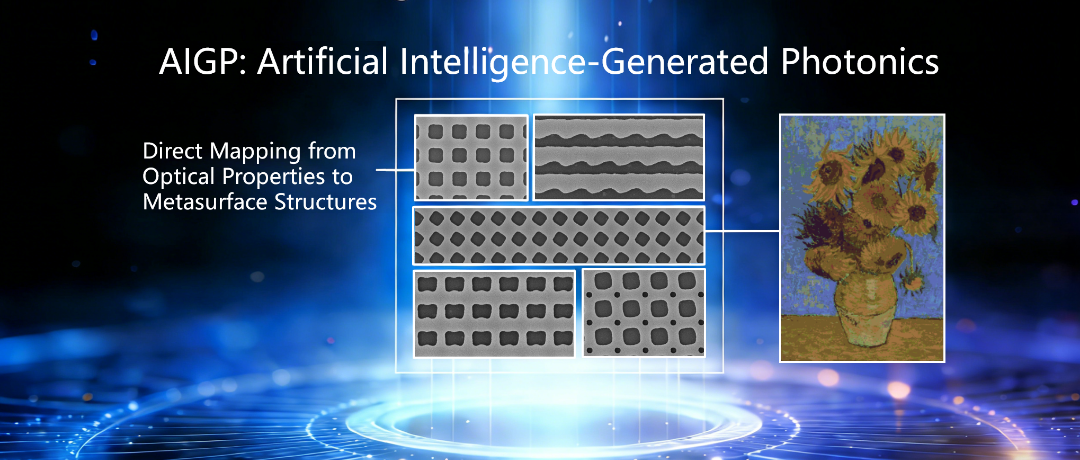
Overview
Recently, the research team led by Professor Kaiyu Cui and Professor Yidong Huang, Founder of Seetrum and from Tsinghua University, publihed a paper titled Artificial Intelligence-Generated Photonics: Mapping Optical Properties to Subwavelength Structures Directly via a Diffusion Model in the journal Light: Advanced Manufacturing.
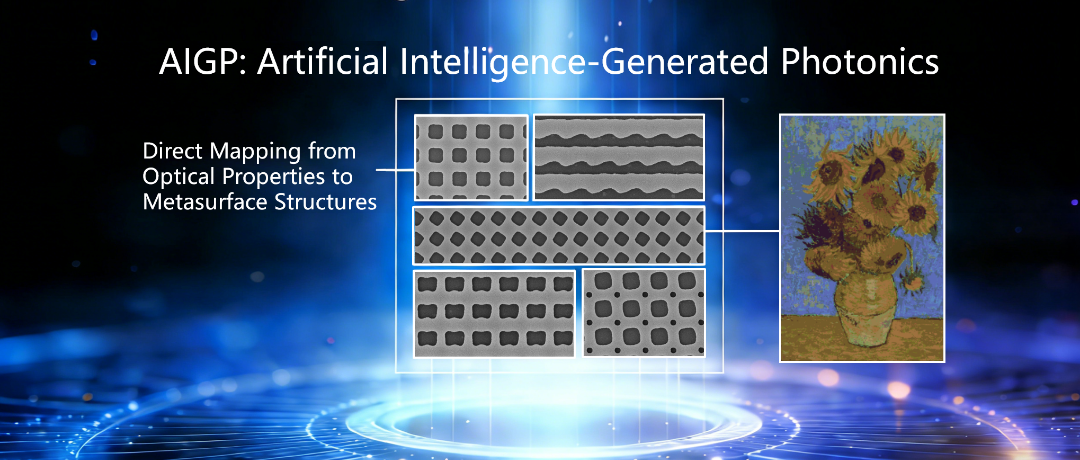
Leveraging the powerful generative capabilities of artificial intelligence, this study proposes a practical inverse design methodology named AIGP (Artificial Intelligence-Generated Photonics) based on diffusion models. This technology establishes a direct mapping from optical properties to structural parameters, breaking the long-standing bottleneck of traditional design workflows that rely on forward simulation and repeated iteration. Specifically, the framework takes target optical characteristics as "prompts" to guide the generative model to accurately create qualified optical structures. Simulations and experimental results verify that this method can produce high-fidelity, manufacturable subwavelength metasurfaces while complying with multiple optical constraints including transmission power, phase and polarization responses. This breakthrough is poised to reshape optical design paradigms and blaze new trails for the rapid R&D and efficient manufacturing of advanced photonic devices.
Light manipulation stands as the core driving force for the advancement of modern photonics. Subwavelength structures such as photonic crystals and metasurfaces have revolutionized conventional optical control methods and enabled precise, efficient light field regulation. Given that their feature sizes are smaller than the wavelength of light in the medium, such subwavelength structures cannot be analytically modeled via geometric or wave optics. Traditional design approaches mainly select optimal solutions from a limited library of predefined structures based on forward simulation. Although emerging inverse design methods can generate counterintuitive yet high-performance optical structures and expand the design space, they essentially convert design tasks into optimization problems and require iterative algorithmic searching. Each iteration demands numerical simulations such as the finite-difference time-domain (FDTD) method for forward modeling, resulting in enormous computational overhead. Additionally, these approaches are plagued by common challenges of optimization algorithms, including convergence issues, low efficiency and difficulties in obtaining global optimal solutions.
The booming development of AI-generated content and AI for Science has proven the strong potential of deep neural networks across image synthesis, intelligent dialogue, pharmaceutical research, chemical analysis and mechanical engineering. Nevertheless, multiple obstacles still hinder the practical application of generative AI in optics, such as the non-uniqueness and non-existence of solutions, difficulties in embedding fabrication constraints, limited model generalizability, and inconsistent input data distribution between training and deployment. These limitations confine most existing methods to one-to-one mapping within preset spaces, making it hard to achieve flexible and universal optical structure generation.
In this work, the team puts forward an inverse design method based on latent diffusion models, namely AIGP, which enables direct mapping from optical properties to optical structures. Capitalizing on the superior image synthesis capability of diffusion models, this method greatly expands the design space and facilitates the creation of innovative optical structures. Within this framework, predefined optical properties act as prompts to direct the model to generate targeted optical structures accurately. To realize direct mapping, the team develops an encoding scheme for optical properties and builds a prompt encoder network. This design resolves the non-uniqueness issue that causes training divergence in neural networks, and also provides an interactive interface for on-demand optical structure design. Meanwhile, a fast forward prediction network is introduced to drastically accelerate simulation processes and support end-to-end training.
The training dataset constructed in this research consists of structures with arbitrary shapes, which maximizes the design space while complying with fabrication requirements. Compared with conventional technologies, AIGP addresses three core pain points in inverse design: solution non-uniqueness, poor robustness against unseen inputs, and reliance on iterative optimization. It overcomes key obstacles restricting the development of this field and opens up new directions for optical design based on deep generative models. Furthermore, diffusion networks outperform Generative Adversarial Networks (GANs) in training stability and generation performance, and feature excellent scalability for large-scale, complex generation tasks. They are capable of producing freeform structures with diverse topologies. The prompt encoder network also bridges the gap between abstract design requirements and practical optical responses.
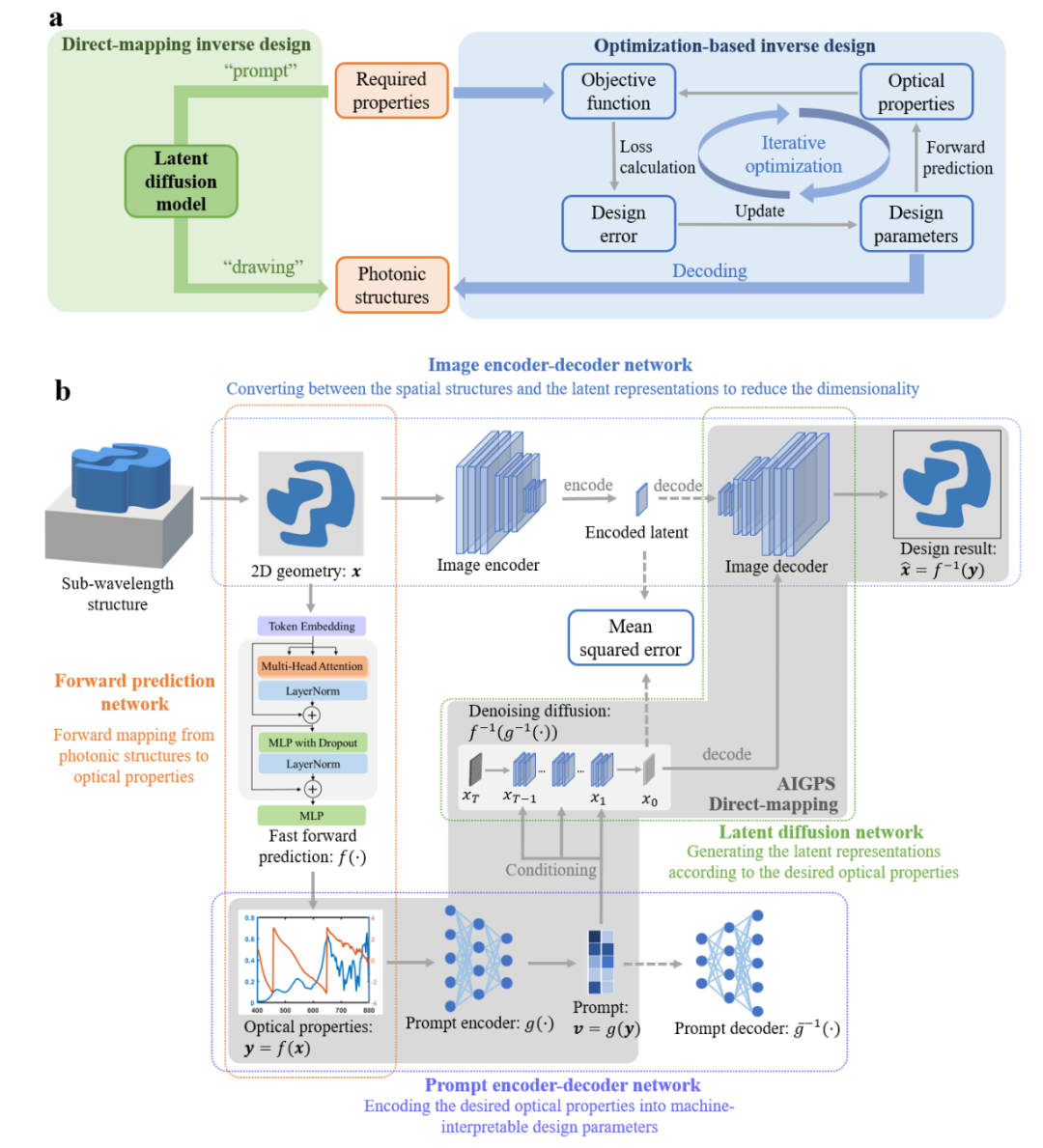
The AIGP method successfully achieves direct mapping from optical properties to subwavelength metasurfaces. It completely eliminates the dependence on iterative optimization in traditional inverse design. By building training datasets that incorporate fabrication constraints, unmanufacturable microstructures are filtered out at the source, realizing comprehensive improvements in design efficiency, design space and process compatibility.
Core Technical Advantages
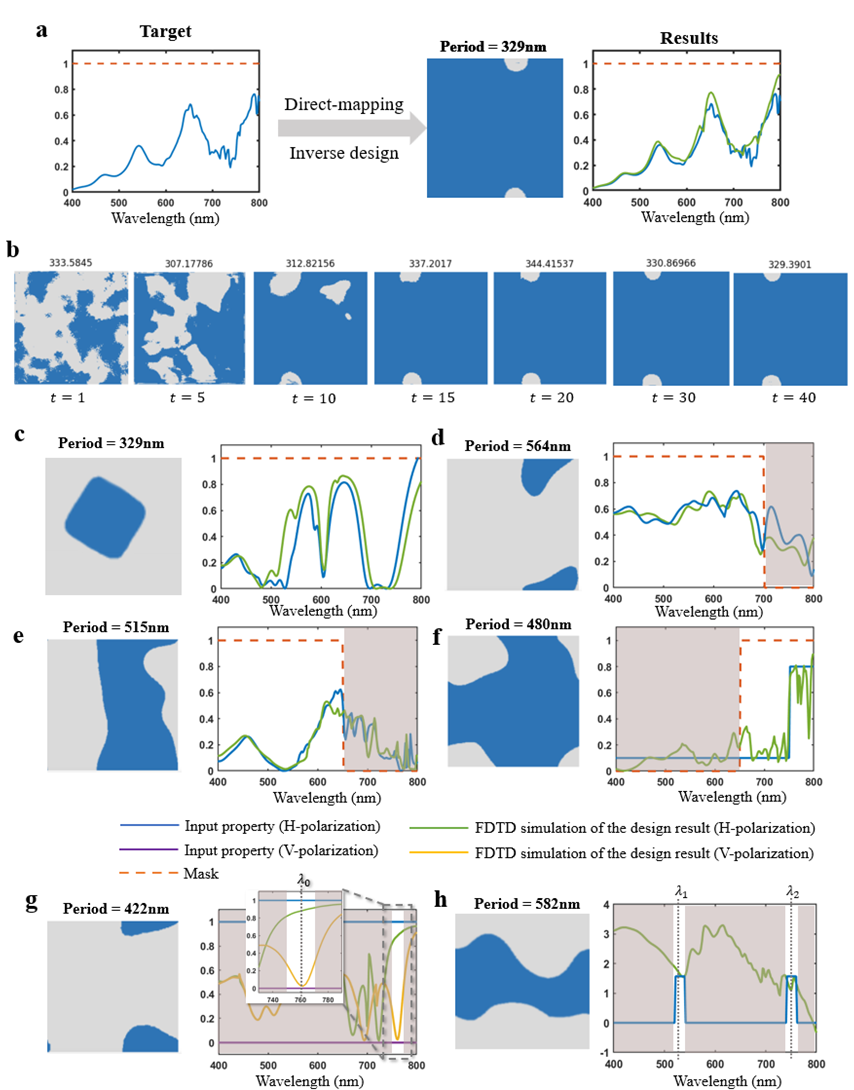
High-precision mapping capability:it can directly map full-band transmission spectra to corresponding meta-atoms. Meta-atoms tailored for transmission spectra, phase spectra and polarization responses can all be generated within seconds and are ready for fabrication.
Flexible design constraints: it supports generating polarization-insensitive devices with C4 symmetry, and allows masking specific spectral bands to adapt to diverse design objectives.
Fuzzy search function: it can deliver near-optimal solutions even with vague design requirements defined by abstract parameters such as cutoff wavelengths, eliminating the reliance on precise forward modeling.
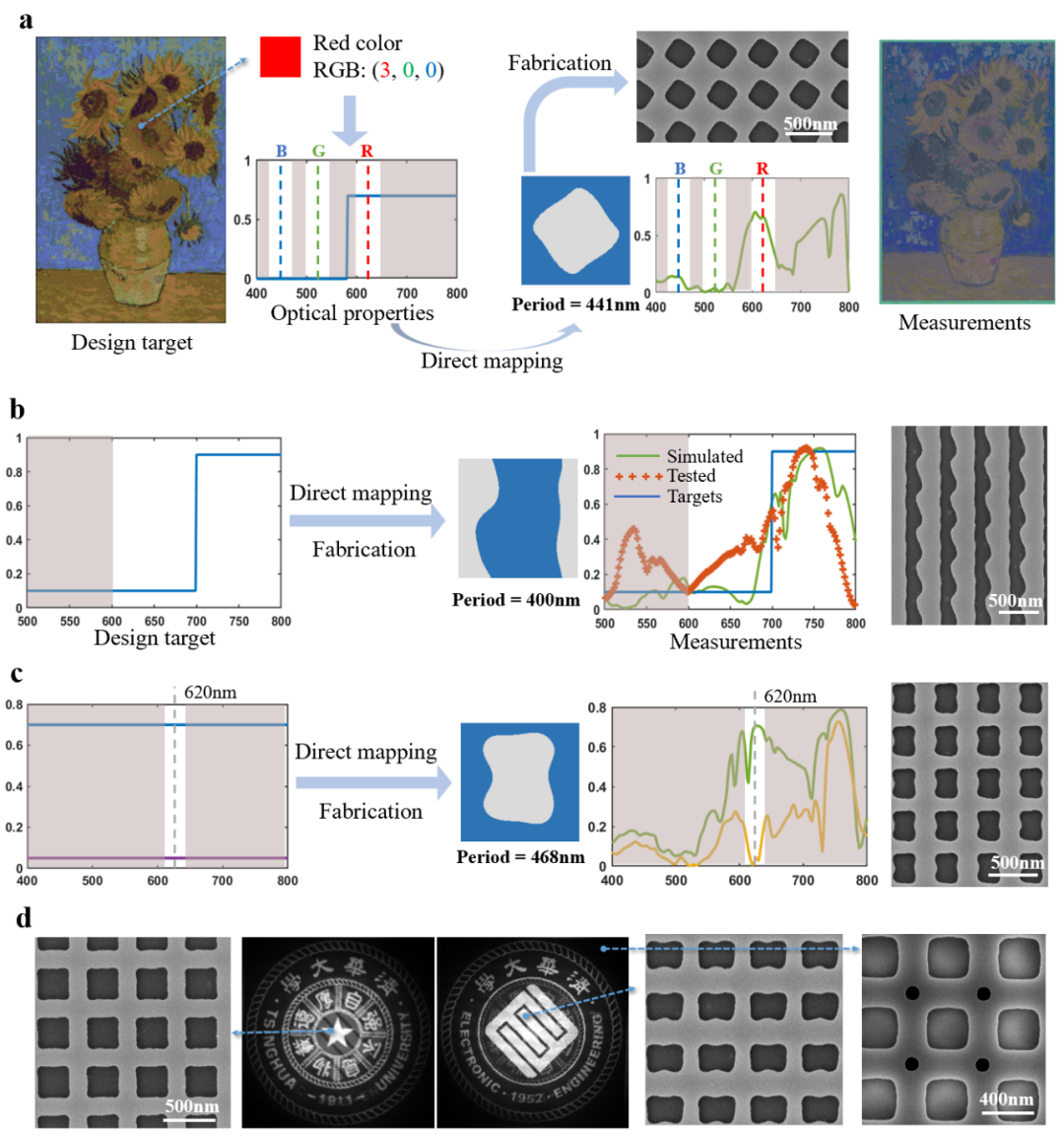
The research team conducted fabrication and testing on silicon-on-sapphire (SOS) chips. Using transfer learning to fine-tune the model, they generated and fabricated 64 types of structural-color meta-atoms on a 230 nm-thick silicon layer, and successfully encoded a sunflower painting onto the chip surface. This fully verifies that structures generated by AIGP are compliant with manufacturing requirements.
When tasked with designing physically unattainable ideal long-pass filters, the method can still deliver near-optimal solutions within seconds, and the measured transmission spectra are highly consistent with design curves. Its outstanding performance in developing bandpass filters, polarizers and multi-wavelength phase modulators further proves its strong generalizability across diverse design scenarios.
Full-cycle experiments from simulation to fabrication and testing systematically validate the reliability of the AIGP method. It requires no iterative optimization, and all generated structures meet fabrication standards, enabling a seamless transition from design to physical prototypes. While reshaping optical design paradigms, this technology paves a new path for the rapid R&D and high-efficiency manufacturing of high-performance photonic devices.
Summary & Outlook
Although metasurfaces are adopted as the verification carrier in this study, the core framework of AIGP has great potential to be extended to large-scale photonic structure design. Taking large-aperture metalenses as an example, their geometric profiles can be efficiently compressed via image encoders, and diffusion models excel at generating high-resolution images — the combination creates a viable technical route for large-scale inverse design. In addition, AIGP natively supports multi-physical quantity input. By simply adjusting the dimension of the prompt encoder, multi-dimensional design targets including transmittance, phase and polarization can be integrated into a unified control vector, demonstrating remarkable flexibility and universality.
More importantly, this study reveals the scalability of frameworks combining Transformer and diffusion models in photonics. The prompt encoder and forward prediction networks adopt architectures derived from large language models, while the image encoder-decoder modules share the technical foundation of Stable Diffusion. With sufficient training data, researchers expect to build general large-scale photonic models in the future, driving AI evolution from designing specific structures on demand to understanding universal optical representations, and fostering in-depth integration between artificial intelligence and photonics.
Paper Information
Shijie Rao, Tianhao Liu, Jiawei Yang, Yali Li, Shengjin Wang, Xue Feng, Fang Liu, Wei Zhang, Yidong Huang, Kaiyu Cui. Artificial Intelligence-Generated Photonics: Mapping Optical Properties to Subwavelength Structures Directly via a Diffusion Model[J]. Light: Advanced Manufacturing 7, 37 (2026)
DOI: https://doi.org/10.37188/lam.2026.037