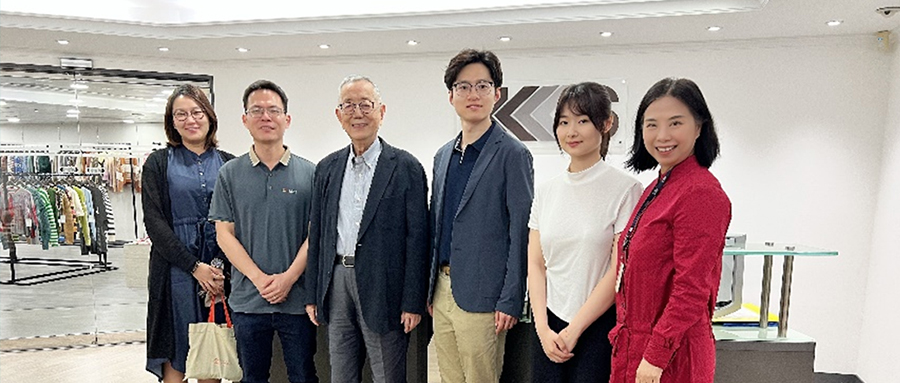



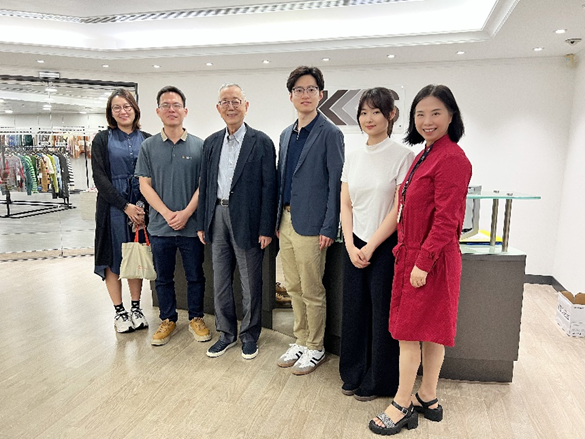
On April 13, 2026, Dr. Zhu Hongbo, Postdoctoral Researcher at the Laboratory of Micro-Nano Optoelectronics, Department of Electronic Engineering, Tsinghua University, together with Wang Junwei, Sales Manager of Seetrum, paid a visit to Hong Kong Wai Sun Group. The team met with Mr. Li Yin Hoi, Chairman of the Group, and held in-depth discussions with relevant staff. This exchange facilitated close communication between academia and industry, as well as forward-looking conversations on the future of color sensing technology.
"Traditional color testing methods are increasingly struggling to meet the diversified and personalized demands of the textile industry," Dr. Zhu noted. Throughout textile production, from raw materials to finished goods, color consistency and accuracy remain core challenges for quality control.
Conventional single-point colorimeters are ill-suited for large-area samples with uneven surfaces and inconsistent hues. Meanwhile, push-broom spectral imaging color measurement systems suffer from low efficiency and complicated operation. These pain points are particularly prominent during Incoming Quality Control (IQC) and Outgoing Quality Control (OQC) procedures in textile manufacturing.
1. Technological Innovation
Seetrum has developed the SEE9830A Area-array Multispectral Color Measurement System, breaking down technical barriers in the color measurement sector. This achievement is built upon years of dedicated research at the Laboratory of Micro-Nano Optoelectronics, Department of Electronic Engineering, Tsinghua University.
Equipped with the self-developed Lancai® Snapshot Spectral Imaging Chip, the system adopts innovative pixel-level broadband spectral modulation technology. It captures 2D visual data and full-area spectral information simultaneously with just a single exposure.
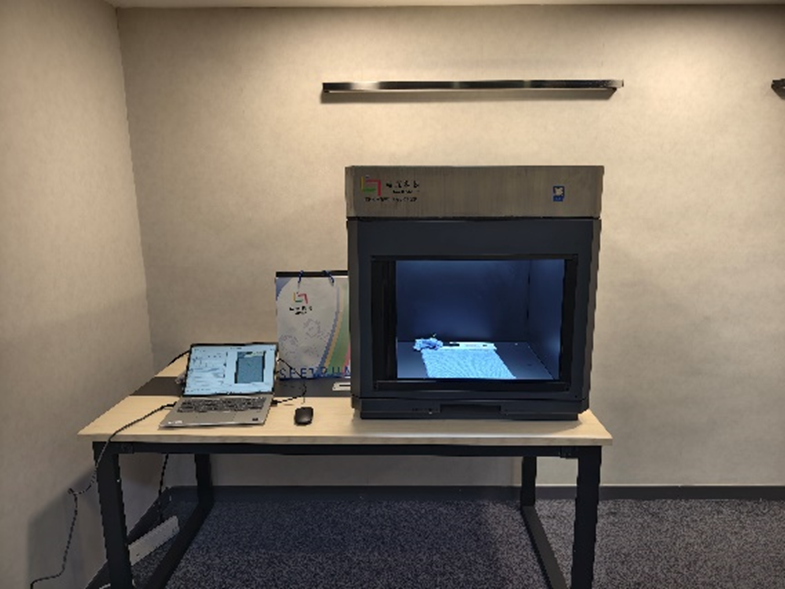
"Our technological breakthrough lies in eliminating the need for complex optical paths, sophisticated optical components and mechanical scanning structures," Dr. Zhu explained during the on-site demonstration. The highly integrated and miniaturized design not only drastically boosts color measurement efficiency, but also ensures excellent system consistency and high manufacturability.
Tailored for the textile industry, the SEE9830A is optimized for diffuse reflection samples featuring flat surfaces, uneven color distribution, irregular shapes and granular textures. It can measure multiple colors and various samples at 1-second intervals, enabling large-area, non-contact and multi-target synchronous color detection.
2. Industry Exchange
During the visit, both sides thoroughly discussed color control difficulties across the textile production chain. "Long-standing issues including poor color communication, slow production iteration and complicated color formulation have plagued the industry," said Mr. Wang.
As a key link in the industrial chain, Wai Sun Group boasts rich experience in IQC and OQC management. Led by Mr. Li Yin Hoi, the team gave an on-site tour of the group’s color testing and R&D laboratories, showcasing its profound expertise in color sample management and product development.
Beyond production techniques, Mr. Li also has in-depth knowledge of oil painting, embroidery, film culture and other art forms. He commits to integrating artistic elements into product design, promoting artworks and supporting intangible cultural heritage crafts and artisans, which greatly enriches the design and connotation of products.
Mr. Li emphasized the vital role of color in both manufacturing and artistic expression. This multi-dimensional understanding of color aligns perfectly with the abundant color data delivered by spectral imaging technology.
3. On-site Verification
In accordance with Wai Sun Group’s production workflows, Dr. Zhu demonstrated multiple operating modes of Seetrum’s area-array multispectral color measurement system, verifying its outstanding performance on samples with complex textures and uneven coloration.
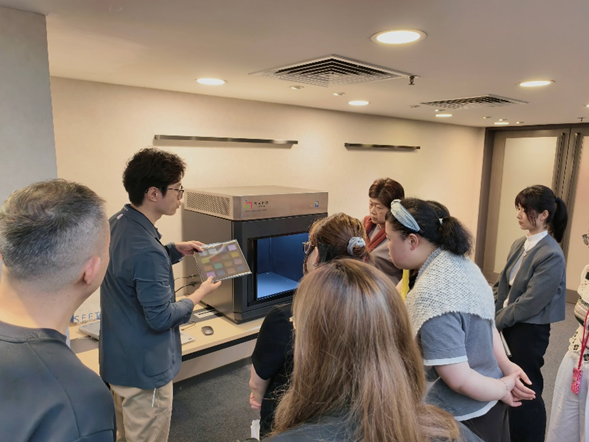
Tasks that used to require repeated measurements and manual data stitching with traditional methods can now be completed with just one shot using the SEE9830A. The high-efficiency testing solution is expected to greatly shorten production cycles and reduce rework caused by color deviation.
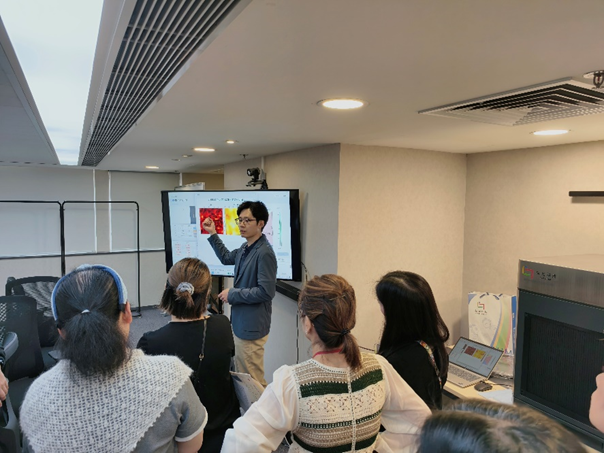
Wai Sun Group’s team will conduct follow-up testing and validation on the system, exploring its practical application in every production process. "We aim to deliver value to the entire industry and help enterprises improve production efficiency and product quality," Dr. Zhu stated.
This demonstration marks the start of in-depth integration of industry, academia, research and application. From laboratory research to production lines, Seetrum’s spectral imaging chip technology is successfully translating scientific achievements into real industrial solutions.
4. Future Outlook
Mr. Li Yin Hoi has long supported the development of the Department of Electronic Engineering at Tsinghua University. He expressed great satisfaction upon witnessing these research outcomes deliver tangible industrial value, and spoke highly of the technological achievements from Tsinghua University and Seetrum.
Dr. Zhu extended gratitude to Mr. Li for his long-term support. "With your continued backing, we hope our technologies and achievements can feed back into related industries and drive quality improvement and efficiency gains in manufacturing," he said. Such positive collaboration represents the ideal model for industry-academia partnerships.
Driven by consumption upgrading and growing demand for personalized products, the textile industry sets increasingly stringent requirements for color accuracy and consistency. Seetrum’s area-array multispectral color measurement system provides a timely and effective solution.
Color has always served as a bridge connecting aesthetics and technology, ranging from artistic creation and intangible cultural heritage crafts to modern industrial manufacturing. Seetrum’s spectral imaging chip technology is paving the way for more accurate and efficient color management.
As cutting-edge technology meets color science and industry-academia collaboration deepens, the traditional textile sector is undergoing a quiet yet profound transformation — powered by an innovative domestically developed spectral imaging chip from China.